• All Recent Posts
    • Art
    • Film
    • Home
    • Literature
    • Music
    • Opinion
    • Philosophy
    • Poetry
    • Theology

Brain in a Vat

  • A Philosophy paper exploring the question of survival

    January 4th, 2023

    The “Argument from Psychophysical Laws” was maybe the most challenging concept I encountered in my first-year Philosophy class (the same class that produced this essay). Derived from Princess Elisabeth of Bohemia’s challenge to the belief in immaterial souls, it begins by establishing a principle named “RED”. In order to understand “RED”, we must conjure up the experience of observing a red object; usually, we may then assume that, “if X has physical property P, then X’s soul has a reddish sensation.”

    The argument posits the conditional, “if immaterial souls causally interact with the material world, generalizations like RED are fundamental laws of nature.” The next premise affirms, “generalizations like RED are not fundamental laws of nature.” Therefore, the conclusion follows that, “immaterial souls don’t causally interact with material things.” If this is true, there is no reason to believe in immaterial souls. They would not be capable of affecting our bodies, and presumably our identities, in any way.

    I, however, maintain that humans possess souls and that our bodies will also be resurrected at the end of time. Since our resurrected forms will also correspond to our earthly identity, I also believe it safe to assume our psychological self will survive. Therefore, mind, body and soul, will all survive corruption and not suffer death. That is my “theory of survival”, and so I therefore acknowledge belief in an afterlife.

    Although questions regarding all my theories emerged throughout the class, I will only discuss the matter of souls because it was the most challenged belief out of all these. In retrospect, my worldview did not alter, but it certainly became more complex. It was good to ponder this, for regardless of the difficulty I faced trying to articulate my position, the process ultimately ascertained my original conviction.

    In order to disprove the argument, I will take two principal directions. First, I will demonstrate how generalizations like “RED” are laws of nature, rejecting the second premise of the argument above. Nevertheless, I will grant I may be wrong about this claim, so I will argue, further, that even if generalizations like RED are not laws of nature, souls may still exist and interact with material bodies. In this scenario, I do not reject a specific premise but rather, claim the argument is invalid; its conclusion does not follow from its premises. The skeptic may, perhaps, be convinced by either one of the two allegations. If they reject one, he could, I believe, concede to the other.

    The RED generalization is possible through the existence of so-called “psychophysical laws”, from which the argument derives its title. The argument states psychophysical laws that govern the interaction between body and soul cannot possibly exist in nature. It would be insuperably complex, and it is simpler to admit sensations and perceptions are merely physical. The simpler explanations of the world are likely to be the more accurate ones, and so we must consequently reject the idea of psychophysical laws responsible for body-soul interactions.

    I instead affirm that these “laws” may not be complex like the argument would have us believe. The soul may operate within the body in perhaps the very same way a skeleton provides the underlying structure for our muscular system. The state of the soul affects the state of the body, and vice-versa. Through a process we do not yet understand, the soul converts non-physical impulses into physical reactions among neurons regularly firing in the brain. Now, one may begin to wonder whether this does not imply an even further complication of mind-body relationship. Rather, I maintain that non-physical things become physical all of the time. Take the concept of knowledge, for instance. Pure “Knowledge” in and of itself does not exist within space. It only “becomes” physical when neurons develop pathways recording knowledge in physical memory. Similarly, “love” is not a concept that exists in space, but one may feel its effects through biological reactions.

    A possible objection to this could be that ideas like love and knowledge only exist within the human physiological experience. However, I believe the same can be said of souls; they only exist in this world when they are, in a figurative sense, “attached” to a body.

    While we have not discovered the laws that govern mind-body interaction, there are still numerous laws of nature that are absolutely mysterious but which we all accept as true. Gravity is the most apparent one, for we cannot exactly explain how massive objects attract each other; they simply do. While we have theorized the existence of quantum particles called “gravitons” (Krestin), the “material” essence of gravity is still in the realm of speculation. We could say the same of the other three fundamental forces of nature; we do not exactly know how electromagnetism and the strong and weak nuclear forces emerge, but we can observe their effects. Indeed, the “emergent properties of the universe” remain one of science’s greatest unsolved mysteries. Many intellectuals throughout our history have theorized the existence of the soul based on the experience of sensations beyond the scope of the material, and so, it is at the very least least probable they were not entirely without reason. After all, we may reasonably claim to feel the effects of possessing a soul, even if the soul ellicits thoughts and feelings without sensible or perceivable interaction, in the same way we observe how bodies behave obeying the contactless force of gravity.

    Notwithstanding this, one may choose to argue there is a difference between these ideas: we can explain the causal relationships of gravity using mathematical equations, while we cannot do the same for the soul. Still, I consider the lack of an accurate semantic an insufficient reason to discard the plausibility of souls. For all we know, we have not yet discovered the best language to describe the immaterial.

    That is not the only way we can arrive at the conclusion souls interact with physical bodies. We may point to any number of scientific facts still awaiting explanation. Why is it that, according to the “double slit experiment”, electrons behave like particles or waves depending on whether or not they are being watched (Marianne)? How is it that most of the universe is made from a “dark energy” and “dark matter, which we cannot measure and scarcely know anything about (Seife)? As many “worshippers” of scince would remark, just because science has not yet explained something does not mean it will not be able to do so in the near future—therefore, I can say, while science does not currently demonstrate how the soul relates to the body, there is no reason to think we might not discover new and surprising paradigms that may resolve that mystery.

    In any case, we must return to our original argument and consider that the objector may still doubt me. Are “RED”ish sensations even laws of nature? I will grant that they may not be, but that this does not matter at all, because the Argument from Psychophysical Laws is not even valid. We cannot assume the conclusion, “Immaterial souls don’t causally interact with material things” if “generalizations like RED are not fundamental laws of nature” because in order for the soul to interact with the body, it need not conform to the laws of nature at all. Indeed, laws of nature only apply to matter and energy, and we cannot suppose the same natural laws govern a spiritual world we know nothing about.

    However, that does then raise the question, how do souls operate through a body which does, in fact, obey the laws of nature? On the one hand, the answer to this question is beyond our realm of understanding at present. It may, in turn, provide a humble solution to the problem soul theory’s “complexity”. It is possible that the soul’s relation to the body is extremely simple, albeit undiscovered. Perhaps, or even indeed, the “physical” is incapable of discovering the conclusive proof of the “spiritual” and immaterial, but can only describe it through the experience of its effects. On the other hand, it is still possible to list various arguments in favor of the existence of souls, regardless of the fact their exact manner of “operation” remains unknown.

    Recall that the state of the soul is able to affect the state of the body without any physical contact. Think also of how immaterial concepts like love become physical once they exist in thought. We may then wonder: how and why do events in nature elicit corresponding responses in humans? Why, for example, do we experience joy, grief, hope, or anger? In one sense, of course, the answer is obvious. According to our evolutionary history, we developed emotional responses advantageous for our survival—the zest to keep on living in the face of difficulty, the anger to defend ourselves when attacked, and the sadness when one of our own perishes—a scientist can reasonably trace the origins of these responses. But there are certain emotions in the range of human experience which cannot be so simply described.

    For a clear example, consider the case of an author completing his first novel. Let us suppose he has just finished the epilogue and is ready to send his work to a publisher. Then, by an unfortunate accident, he deletes the document where the entire novel was stored. Being careless, the author did not save the manuscript anywhere else, and now the only copy of the writing is gone. The frustration experienced is beyond reason; perhaps tears and shouts of disapproval ensue. But ultimately, does this man’s novel add anything to his chances of survival? Is not all art useless, from a strictly naturalistic point of view? It is difficult to conceive how the artistic impetus could have survived evolution. While you may, in opposition, state that creativity and ingenuity are necessary and beneficial qualities for the survival of a species—thus justifying their presence in the human mind—I would only respond that the human desire to beautify and ornament the world is not, in fact, necessary. Indeed, “decoration” can even be an obstruction to innovation and practicality; beauty might be detrimental to our survival.

    According to a traditional theistic faith, God breathed life into humans and made us in His image, making us unique among all creatures. All the traits which were perplexing under naturalism suddenly alight when we imagine the possibility of our spirtual essence, our immaterial home. This leads nicely to an argument I created and titled, the “argument from unreasonable emotions”:

    1. Human beings have a many traits that do not appear to have evolutionary origins.

    2. The traditional conception of the soul includes the notion that unique aspects of the human mind belong to the spiritual identity.

    3. The connection between these aforementioned traits and their origin within the immaterial essence of a person implies the existence of the soul.

    C. There are immaterial souls.

    Another argument that may help spark credence to the belief in souls is what I consider to be “the argument from consciousness”:

    1. Science cannot explain how and why humans are conscious creatures.

    2. A belief in the immaterial soul implies our most profound identity—and consequently, our self-awareness—reside in the soul.

    3. Traditional beliefs about souls do explain the reason for consciousness.

    4. Traditional beliefs about souls are accurate.

    C. Souls exist.

    The simplest response to this argument would be to reiterate the principle I established in the former discussion, that science may in the future develop an explanation for consciousness even though we do not currently possess it. However, this line of reasoning does not deny a specific premise of the argument. I would even pose the question: what if, just maybe, the reason for consciousness and the undiscovered source of soul-body interaction are one and the same? What if consciousness actually emerges from the soul’s interaction with the body? It would certainly justify why both of these subjects remain mysterious. This is simply food for thought, and I admit, it is a weaker argument. But maybe, it will still aid in the ultimate goal.

    My third and final argument for the existence of the soul is related to linguistics. My reasoning here is still rather primitive, so bear with me. Maybe in the future, I can develop this initial sketch of an argument more cohesively.

    For this argument I rely on Noam Chomsky’s concept of the “Language Acquisition Device”. The Oxford Encyclopedia defines it like so:

    (The Language Acquisition Device is) “a hypothetical mechanism, based on generative grammar, introduced in 1964 by the US linguist and philosopher (Avram) Noam Chomsky (born 1928) to explain how children acquire internalized knowledge of grammar with remarkable speed on the basis of fragmentary and degenerate input data. The language acquisition device is assumed to be a biologically based innate capacity for language, independent of any specific natural language, that enables a child exposed to adult speech to implement certain general principles for discovering the grammatical rules of the specific language in question.”

    With this in mind, I introduce my “argument from language”:

    1. The Language Acquisition Device assumes the preexistence language.

    2. At some point, words were developed.

    3. Unless the offspring of the creatures who first developed the language possessed the Language Acquisition Device, this language could not be passed on to future generations.

    4. It is impossible for the means by which humans express themselves and the selfsame method of expression to have evolved simultaneously.

    5. Language was passed down from generation to generation.

    6. There may be, in the absence of another reasonable explanation, an immaterial origin to the Language Acquisition Device.

    7. It is possible for a soul to grant the body complementary qualities necessary for language to evolve.

    8. It is possible for a soul to grant the offspring of the first “language-bearers” those qualities necessary to gradually develop an understanding of language.

    9. These “possibilities” align with the reality of what happened in the past.

    C. Souls then exist.

    In response, it would seem plausible to claim the process we use to understand language is very demonstrably physical; after all, the left hemisphere of the brain controls it. But notice how my particular focus is on the question of how infants first begin to process language; I believe it is only in light of this subject that this theory makes sense.

    To close the discussion for the present moment, I will liken the idea of the soul to a pleasant symphony. As we know, the music instruments produce is nothing beyond vibrating matter. Tuned to the right frequencies, consonances emerge, inexplicably lovely to our ears. Likewise, humans are tuned to a set of conditions allowing God’s “breath of life”, the soul, to dwell within us. This soul is as real, meaningful, and curiously strange as the satisfaction of the right harmony. Yes, the orchestra is merely made up of pieces of wood and brass assembled in a particular manner. But that does not change the otherwordly sensation of a beautiful symphony, the floating, mystical combination of all that physical “stuff”. And the soul, according to my view, is like an emerging melody from our weary clump of flesh—it is our heavenly essence, unseen, yet most clearly and evidently perceived.

    Works Cited

    Krestin, Greg. What is Gravity Made Of? PBS NOVA Science Trust, 7 July 2014, https://www.pbs.org/wgbh/nova/video/what-is-gravity-made-of/. Accessed November 9 2021.

    Marriane. Physics in a Minute: the double slit experiment. Plus Magazine, 19 November 2020, https://plus.maths.org/content/physics-minute-double-slit-experiment-0. Accessed November 9 2021.

    Seife, Charles. “What Is the Universe Made Of.” Science, vol. 309, no. 5731, American Association for the Advancement of Science, 2005, pp. 78–78, http://www.jstor.org/stable/3842149.

    Overview: Language Acquisition Device. Oxford Reference, https://www.oxfordreference.com/view/10.1093/oi/authority.20110803100051869. Accessed November 9 2021.
  • Keatsian Influences in Wallace Stevens’ ‘Sunday Morning’

    January 4th, 2023

    Keats listening to a Nightingale on Hampstead Heath

    Sunday Morning, by Wallace Stevens

    To Autumn, by John Keats

    “Death is the mother of beauty”, says Wallace Stevens, completing the thought initiated by his precursor, John Keats, when he stated, “‘Beauty is Truth, Truth Beauty.’ – that is all / Ye know on earth, and all ye need to know” at the conclusion of his poem ‘Ode to a Grecian Urn’. Despite being a Modernist, Wallace Stevens was greatly inspired by the Romantics, a fact made evident by merely analyzing his poetry. Although one might easily identify the Keatsian parallels in Stevens’ poetry, I will argue a more profound assessment reveals that Stevens in fact amplifies, redefines, and transcends Keats’ original import. Investigating both the similarities, and especially, the contrast between the poems ‘Sunday Morning’ and ‘To Autumn’ demonstrates this point precisely.

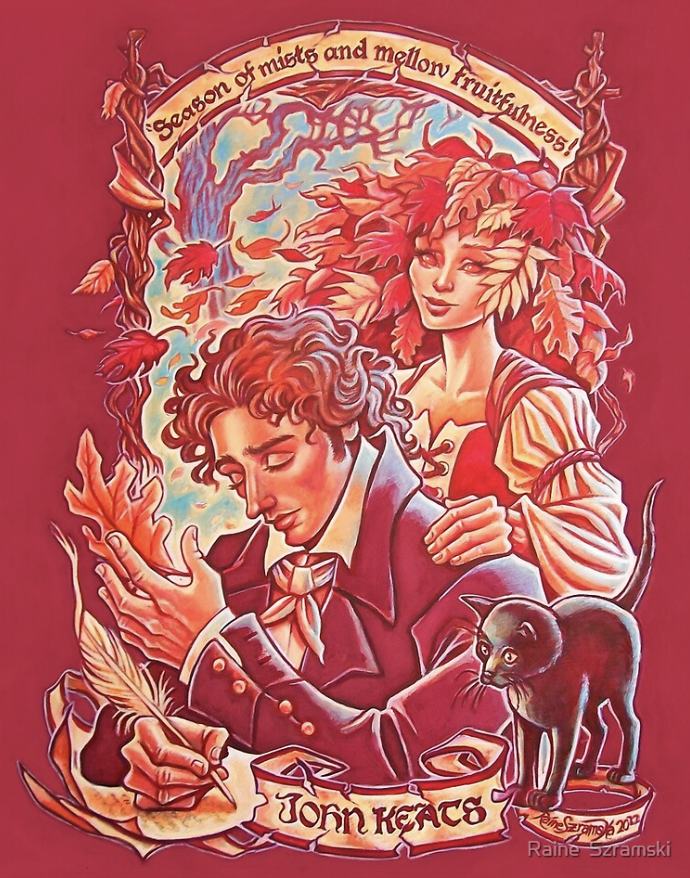
    “To Autumn” is one of the most perfect descriptions in the English language not only of the abundance of the season but also of the melancholy atmosphere of nostalgia. Within the very first verses, Autumn appears personified as a beautiful woman, an intimate companion of Summer, who sometimes works with him so that the vines fill with bunches and the apples ripen, sometimes falls asleep in the field, numb by the aroma of poppies. This celebration of Autumn, personified and carrying pantheistic overtones, is naturally not exclusive to Keats, as both William Wordsworth and Samuel Taylor Coleridge also wrote variations on this subject. However, two elements make the selected ode superior: the harmonious connection between nature and the “mental landscape” it evokes; and the vivid detail and sensuality present within its bucolic images. Autumn appears essentially linked to melancholy, evoking memories and meditations about existence. Such melancholy is intimately connected to human ephemerality. The awareness that everything is perishable generates sadness, but also a desire to “seize the day”. The poet exhorts the reader to seize the moment, triumphing over melancholy. It makes one more sensitive and therefore able to better appreciate the bitterness and the sweetness of existence.

    The lament for death that autumn announces invites one to celebrate life even as it melts and, heroically, persists shedding its dying colors. The green turns to yellow, red, and orange that cultivate the beauty of vibrancy, proclaiming its last breaths to the sun. It approaches divinity and touches the crevice from which the secrets of death are released, just as closing one’s eyes in front of the sun reproduces the mixture of colors that appear when opening the same. Nevertheless, the death of the leaves remains nature’s final sigh. Indeed, nothing is needed to complement Keats’ ethereal image. However, Wallace Stevens succeeds in amalgamating this revelation together with his own philosophy; yes, Stevens remarks on the short-lived nature of life, but he also adds his reflections on the inseparable unity of artifice and medium, much like their unity in the art of painting.

    In a speech given at the Museum of Modern Art in New York in 1951, entitled “Relations between Poetry and Painting”, Wallace Stevens argued that, in an age of disbelief such as ours, art would work as compensation for what humanity had lost and imagination would now reign supreme, whereas before, faith had occupied such a space: it would, therefore, be up to poetry and painting, artistic forms that operate between imagination and reality, to assume their “prophetic role” and become a “Vital assertion of self in a world where nothing but the self remains, if that remains.” (Stevens 171).

    Avoiding further explorations and explanations about the poem (“once a poem is explained, it is destroyed” Stevens stated in a letter), I would like to approach it from an analysis that approximates it to painting. Stevens’ poetry simultaneously incorporates conflicting elements of impressionism–colors, light, air, impressions, the passage of time (both chronological and climatological)–and cubism–the implosion of the object, mutation, explosion of points of view, simultaneity–in his poetic work. Therefore, he works between nature and artifice, between charm with appearance and the metamorphosis of appearances. Stevens’ sensitivity would therefore be linked to the idea of change. On the one hand, impressionism, with its passive principle of change; on the other, Cubism with the active principle of imagination. Thus, the metaphors of poetry and the metamorphoses of painting draw on the same reservoir of analogies.

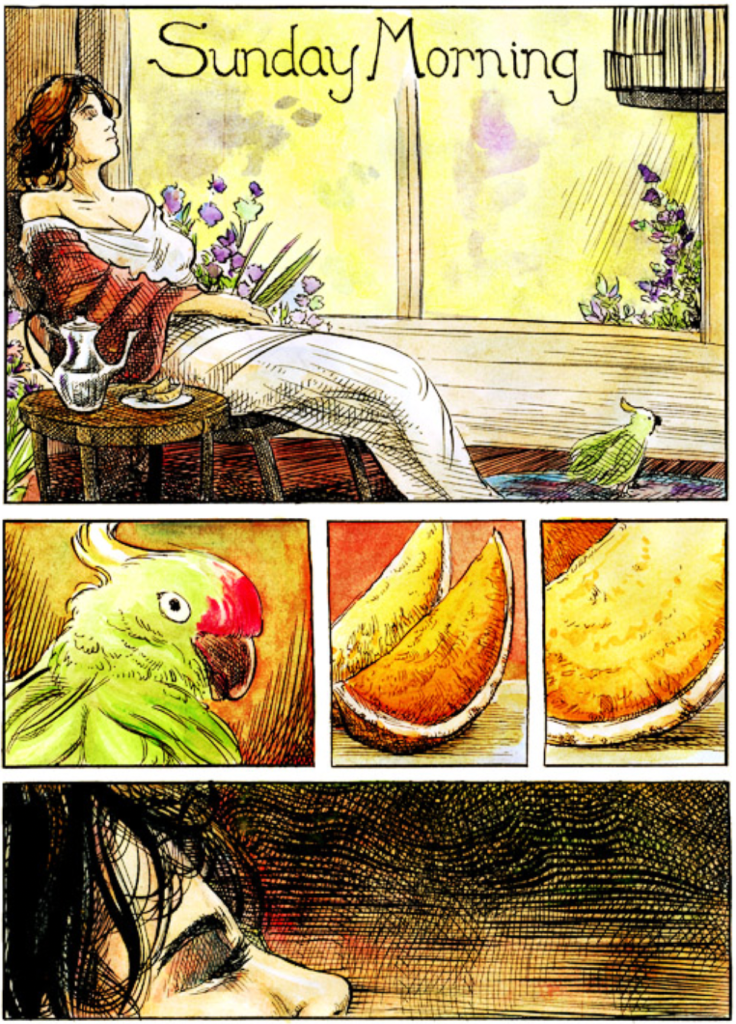
    The poem is a meditative monologue, sometimes in the first, sometimes in the third person. Superficially, it is tied together by references to the central female character: she dreams, she thinks, and she inquires. The character is even emptied of her humanity, without physical characteristics that distinguish her; as in a work by Matisse, she was sacrificed in order to become a decorative pattern. Nevertheless, the author indicates that the poem is not a discursive presentation of arguments with a dialogic evolution–it is in the realm of rhetoric, and not dialectic, that Stevens stages his battle. The central character loses her prominent role, and the narrative fabric is torn. With that, the idea of unity that the poem presents would not be in the female figure, but in its pictorial composition; “Sunday Morning” is not a succession of ideas, but of frames. The first stanza is organized as a diptych: on one panel, the woman sitting on the chair, oranges, the cockatoo, arranged à la Matisse on an oriental rug; in the other, a gloomy lake. Silence accentuates the pictorial characteristic, as well as the spatial notion provided by “As a calm darkens”, and prolonged by, “the day is like wide water”. Such an antithetical pattern, an image of earthly life and a supernatural scene, continues in the following six stanzas and resolution occurs in the last stanza, corresponding directly to the initial diptych, but in reverse order: a formal ordering in the chiasm, raising our aesthetic appreciation for the poem and the balance of the composition.

    The effect of this pictorial method would seem to introduce tension to such a balance. However, the atmosphere of “Sunday Morning” is not tense, and Stevens is not a dramatic poet. Tension, then, is spatial, arising from the juxtaposition of antithetical blocks. The sequential pattern of the poem, therefore, proceeds in a perfect circle. The strength of the poem indicates that it achieves an emotional impact coming from within the daydreams of a meditation that is inconclusive and circular. It represents the triumph of an undramatic poet over his own limitations. Stevens, gifted with a powerful visual imagination, presents the conflict of ideas as the conflict of forms.

    In Stevens’ case, we are not confronted by the pictorial environment that the poem sets in motion, but it is the sound surface of the language that dominates our attention. Sound is the medium, as paint is for, say, Picasso (or Matisse or Manet); we are absorbed more by lexical texture and the most variegated syllables than by statements, placements, or semantics. Words build a double relationship in which language is both referential and self-referential, reiterative and mutative in terms of sound and meaning.

    Thus, I would like to propose a relationship between this poem and the genre of still-lifes. Quite focused on interior spaces and, for the most part, domestic spaces, the still-life painting can present the placid and cozy life of the home through the mediation of objects. It is the artist’s retreat, not as escapism, but as a way of strengthening his spirit for the daily battles against the “pressures of reality” (Stevens 1951: 13). It is in such an environment that profound meditations take place, in such as those proposed in the first stanza of “Sunday Morning”. More than just a composition by Matisse, it is likely the lines that open the poem construct the exact image of a still-life: fruits, vases or mugs, the tapestry; even the exotic bird would not be an unusual item in this genre of pictorial art. If, on the one hand, historical painting is built around a narrative, “still-life”s are the world subtracted from its ability to create narrative interest. Furthermore, Stevens is not working within the (temporal) relation of the dialectic, but rather with the almost immediate presentation of self-centered rhetorical frames; and, if the principal female character is emptied of her predominant role, and the removal of the human figure is the founding principle of the still-life genre, we may then conclude the poem then appears to be constructing a still-life. It is a representation of those things that lack importance, the unassuming material basis of life, (i.e., the orange, the coffee, the cockatoo)–and the representation of things in the world that demonstrate grandeur (the ‘ancient sacrifice’, the ‘dominion of blood and sepulchre’). The equality of importance between these two modes, achieved by being joined together, causes the narrative scale of human importance to be broken. If in the narrative what matters is the conflict and change, in the rhetorical presentation of the poem, narrative is useless. In the still-life, there is no spiritual “Event” and, likewise, the woman chooses not to participate in the grandiose and megalographic narratives of the Church, deciding, on the contrary, to stick with the trivial, with things, with the topographic.

    This abolition of the distinction brought about by the representation of mundane and base things in still lifes poses a threat to representations that consider themselves superior to others, that believe to have absolute access to exalted and elevated modes of existence and experience. There is in commonplace objects a level of simplicity, in the representation of shapes that is “virtually indestructible” (shapes that resist the passage of time practically unscathed: fruits, flowers, cups, plates, pitchers); there is in them a level of familiarity of forms that are legacies; these objects are tied to actions repeated by all their users in the same way, across generations, presenting the lives of ordinary people more as a matter of maintenance and repetition than of originality, individuality, or invention. And it is precisely this threat to grandeur in the face of everyday objects that Stevens is carrying out in the eighth stanza.

    It seems that Stevens loosens the diptych separation present in the poem and instead paints a single picture that presents the simultaneously supernatural and natural, the base and sublime. This approximation can be observed in the relationships between words used in the first half of the stanza that echoes words from the second half, namely, “unsponsored” echoes in “spontaneous”; “island solitude” in “isolation of the sky”; “chaos” into “casual”. These relationships tie together the stanza–even though it is organized as a chiasm of the initial stanza–and unite elements that were previously disparate and disconnected enough to characterize a couplet. Furthermore, Stevens culminates the stanza and the poem with a chain of trivial and natural things–the roe deer, quails, mountains, wild fruits, and pigeons–thus granting greater weight to the common and low elements than to the extraordinary and elevated ones, inverting the value usually given to each of these sides (normally, narrative paintings have more prestige while still-lifes are relegated to a lower position within the world of art). This approximation of the elements on both sides of the stanza, together with the topographic climax–the focus on the trivial–, pose a threat to the elevated, to narrative, and are therefore structurally connected to a variety of still-lifes.

  • Wordsworth’s “Intimations of Immortality”

    January 3rd, 2023

    Intimations of Immortality from Recollections of Early Childhood

    From the onset, “Ode: Intimations of Immortality of Recollections of Early Childhood” by William Wordsworth appears to be a melancholic reflection on the lost idyllic vision of the child through the process of maturation. Wordsworth’s introductory lines, “The child is the father of the man” (Poetry Foundation), elevate the romantic notion of the child as the adult’s superior; the child is also the one who experiences the events that eventually shape one’s manhood, and therefore it is the precursor to the man. Furthermore, Platonic ideals pervade the length of the work and carry its themes to great metaphysical heights. Immediately, then, this poem seems to be quintessentially romantic, glorifying the innocence of childhood to the point of unreality. However, upon a detailed inspection, we discover that Wordsworth does not indeed wish to inhibit the natural process of growth or confine humanity to the merely spiritual world. After all, in the same opening lines Wordsworth states he desires to be “Bound to each”—what could only mean both the child and the man— “by natural piety”. Therefore, the poet argues that a simple hint of perceiving the immortal world reminiscent of childhood is sufficient to better our lives—one need not give themselves entirely to the pursuit of the ideal and briskly abandon the physical world. Instead, a balanced contemplation, and not obsession with, the romantic is what leads to deeper personal inspection and achievement of convivial light.

    The title of the poem first strikes the reader as peculiar. “Intimations”, after all, may have two very distinct meanings. It is either “the action of intimating, making known, or announcing; formal notification or announcement” or merely “the action of making known or expressing merely; an expression by sign or token, an indication; a suggestion, a hint” (OED). In other words, there appears to be a deliberative ambiguity in Wordsworth’s choice of title; is the intimation of immortality a wide proclamation, or is it a subtle gesture toward an unseen reality?

    Heralding the first stanza, Wordsworth recalls a time when the picturesque and the ideal lay entwined in glorious simplicity. The poem begins in the past tense with a phrase typical of fairytale openings, “There was a time…”, signaling that this age is no longer and that a harrowing blindness ensued: “The things which I have seen I now can see no more” (Stanza I verse 9). The poet even attempts to find comfort in nature, a customary, wholesome cure for the romantic. However, Wordsworth subverts the expectation that nature welcomes the distressed and mild of heart. After all, he possesses a distinct, unnerving sense that the sweetness nature can offer pales in comparison to what he has lost. The inklings of despair trickle down as he realizes he may never find the “glory “that “hath past away from the earth” (II, 9).

    In addition to wallowing in bygone shadows, the poet experiences this anguish alone, stating, “To me alone there came a thought of grief” (III, 4). He lists countless beauties one by one, yet despite the bright splendor all around a profound sense of alienation encapsulates him. Here Wordsworth conforms to a romantic trope, that of the anxious poet who envisions the startling beauty of nature as a mocking, antagonistic force to his depression. In time, however, the gayness of “all the earth” (III, 11) eases the pangs of his soul. With exaggerated notions like beasts “keeping holiday” (III, 15), Wordsworth appropriates almost biblical imagery of the surreal utopia, a place where beasts are no longer ferocious (i.e., “the wolf will lie with the lamb” – Is. 11:6). “Thou Child of Joy” (III, 16), he exclaims, perhaps addressing the figure of the child as an abstract concept or indeed his own childhood self, “My head hath its coronal” (IV, 5). A “coronal” may either mean “a circlet for the head; esp. one of gold or gems, connoting rank or dignity; a coronet” or “of or pertaining to the crown of the head” (OED). Thus, the poet is cured of his mental affliction as he dons a symbol of elevated status, much like the gift of Christian salvation gives the individual new attire to “clothe” (Rm. 13:14, Col. 3: 12). In the poet’s case, his balm literally encircles the head, that which originates distress.

    Overwhelmed with the profundity of his meditations, he cries, “I feel—I feel it all” (IV, 6). Once again, he fluctuates and contrasts nature’s beauty with his own dejection: “Oh evil day! If I were sullen / While Earth herself is adorning…” (IV, 7-8). Indeed, the conflict of the poem keeps increasing as the “Children are culling” (IV, 10). Note the unusual interpolation of the word “culling”, which may imply “to gather, pick, pluck (flowers, fruits, etc.)”, “to fondle in the arms, hug, or embrace”, or even, “to select and kill (wild animals or birds), usually in order to improve the stock or reduce the population” (OED). While I do not suggest the children in “Intimations” are in fact killing wild animals, the mere suggestion of an evil deed may indicate how cruelly mocked the poet feels for being unable to achieve the same bliss as the children.

    “—But there’s a Tree, of many, one / A single field which I have looked upon” (IV, 16-17) interrupts the miserable display with a glimmer of hope. Here, the poem’s central argument begins to unfold, but it is a mere hint of what is to come. Wordsworth selects a single piece of the ethereal view before him and decides to focus all his strength upon that desirable object. One cannot help remembering “Tintern Abbey”, wherein he demonstrated equal diligence in observation and continually returned to the beauty of one carefully admired landscape. He then converses with “The Pansy” (IV, 19), flowers that may symbolize love, remembrance, or nostalgia, very much in keeping with the poet’s current emotional state. Inquiring about the location of “the glory and the dream” (IV, 22), the poet conveys the impression that his visage of childhood may be nothing but a mirage or illusion.

    Leaving us on that uneasy note, Wordsworth transitions to the philosophical interlude of the piece, recounting the journey of the human soul in either Aristotelian or Platonic terms—either way, both espoused the preexistence and immortality of the soul. Humans are lonely foreigners to this world, for “The Soul that rises with us, our life’s Star, / hath had elsewhere its setting” (V, 2-3). The younger one is, the closer one is to clarity and enlightenment since the “Boy…beholds the light, and whence it flows” (V, 11-12). Much like the descriptions of the sensible world in Plato’s “Symposium”, Earth distracts the soul with “pleasures of her own” (VI, 1). The physical senses distract man from his path to the true form of things and ideal “being”. By comparing the earth to man’s foster mother (VI, 6), Wordsworth implies this world is rubbish compared to the spiritual realm. But if so, why, we might ask, is so much of the poem dedicated to the praise of nature? It is here Wordsworth subtly invites the reader to beware of a superficial reading of his work. One might be led to think, with all his glorious descriptions of the immortal world, that the poet denounces the bodily as a frail hindrance. However, progressing throughout the poem will reveal the exact opposite.

    Wordsworth recounts the seventh stanza with a moving, pithy outlook on man’s life. Alluding to Shakespeare’s “As You Like It”, he compares man’s life to a “humorous stage” (VII, 15) with its various disorienting, ridiculous parts. The verses in this stanza are short and direct, mirroring the tragicomic perceptions one often finds in life. With the concluding couplet, “As if his whole vocation / Were endless imitation”, Wordsworth posits the argument that there is no originality, creativity, or artistry, in the strivings of most men. In other words, most adults lose their sense of connection to that which is fundamentally human, i.e., the lack of imitation.

    Once more, Wordsworth constructs deliberate ambiguity with the use of the word “belie” to denote the soul’s exterior. “Belie” is “to surround, encompass”, but it may also be “to deceive by lying, tell a lie to.” The body, the home of the soul, is in fact what occludes and imprisons the soul. The poet keeps on praising the child as the true visionary and concludes the stanza by denouncing custom, who lies “upon thee with a weight, / Heavy as frost, and deep almost as life”. Indeed, the Histories of Herodotus is famous for its assessment that custom is “king of all” (187). It seems that human custom is the curse preventing humans from realizing their eternal destiny.

    Emotions proceed in a whirling crescendo as the poet begins to change his mind regarding nature’s ephemerality: “O joy that in our embers / Is something that doth live, / That Nature yet remembers / What was so fugitive!” (IX, 4). Hope is “still fluttering in his breast” (IX, 10), a familiar poetic metaphor featuring hope as a bird. Tension and passion escalate until, midway through the stanza, Wordsworth recreates one of his most famous lines in “Tintern Abbey”: “Uphold us, cherish, and have power to make / Our noisy years seem moments in the being / Of the eternal Silence”—it is impossible to ignore the chiming ring of “the still, sad music of humanity”.

    From then onward, the dawn of hope emerges anew through Wordsworth’s finalizing thoughts. Despite remaining hidden, the secrets of the soul are not completely lost and the reminisces of childhood are not hopeless. After all, “neither listlessness, nor mad endeavour, / Nor Man nor Boy, / Nor all that is at enmity with joy, / Can utterly abolish or destroy!” It is still possible to contemplate immortality and “hear the mighty roars of waters rolling evermore”.

    The poet repeats the sounds of nature’s invitations, “Ye that pipe and ye that play, / Ye that through your hearts to-day / Feel the gladness of the May!” (X, 5-7), yet this time, his jubilant call to action contrasts sharply with the dispirited beginning. Echoing William Blake’s “Auguries of Innocence”, he calls man to see the “splendour in the grass, of glory in the flower” (“To see a World in a Grain of Sand /And a Heaven in a Wild Flower” – Blake). Most shocking of all, Wordsworth invites us to taste the “soothing thoughts that spring / Out of human suffering”. He invites the reader to find beauty even amidst tragedy, which is what makes this poem so radically different than a tale of childhood loss. The “philosophic mind” brings comfort, yet in his heart, the poet feels the force of nature’s “might”. Spiritual enlightenment must come, but there is a caveat: the poet does not completely give up earthly pleasures. Thus, Wordsworth establishes a balance between philosophic speculation and emotional romantic upheaval. It is thanks to this mere “intimation”, a glimpse, of immortality that the poet can face his trials and encounter “thoughts too deep for words”. It is in the liminal space between the physical attractions of the world and its undying and underlying spiritual reality that man must find his peace, and not, as one might initially expect, with a superabundance of one or the other.

  • Why do bad things happen to good people? An extremely condensed response

    January 3rd, 2023

    Há uma versão desta reflexão em português logo abaixo.

    (Background: I was asked by a family member to write a very brief version of my take on this complex question and thought it would be useful to store for future use.)

    In order to answer this question, we must examine the underlying assumption that lies behind it. That is, when one poses this question, one is granting the axiom that there is such a thing as “good people”. Now, I would challenge whether that is the case. According to my experience, no human being can claim to have acted benignly all the days of his life; there is always some failing which must mar even the most virtuous among us. The whole of human history demonstrates that man often brings evil upon himself. Nation goes to war against nation, people who ascend to power abuse it, and most seek to achieve their ends with little regard for the feelings of others. In the Christian worldview, Christ is said to be the only truly good person who suffered unjustly. He was morally perfect, yet he was tortured and crucified. No one is actually good, and therefore the question carries a mistaken principle.

    “Well alright”, you might say, “but let us not treat goodness as moral perfection. A good person is simply someone whose good deeds outnumber their bad ones; they need not be good all the time, but their overall conduct is commendable and their spirit of compassion envious. Why must they too suffer so bitterly?” This question involves a common mistake of viewing isolated, unfortunate events as punishments for particular sins. It is an error to do so, and that was where the crime of Job’s friends lay. Individual causes of suffering are no less explainable than the mysteries of eternal life; both lie hidden under divine providence. Rather, evil occurrences—such as disease and natural disasters—result from the condition resulting since the event of the Fall of Man. That most tragic occasion, wherein the initial beguiling of the serpent led man to shun the goodness of his Maker’s paradise, caused the present fallen state of nature. Whether the story is taken to be literal or metaphorical, it is the principle of self-sufficiency, the continual decision to rule over the throne of our heart instead of relying on the source of all Goodness—that principle alienates us from God and forces us to encounter him through religion here on earth.

    As John Milton states in the opening lines of “Paradise Lost”, the cause of suffering is, “of Man’s first disobedience, and the fruit of that forbidden tree, whose mortal taste brought death into the world, and all our woe.” Finally, another question may arise: but why must mankind be punished for the fault of a single man? Well, to put it simply, let us state how theologians understand that if anyone had been in Adam’s place, their choice would have been the same.


    Por que coisas ruins acontecem com pessoas boas? (Tradução)

    (O que me motivou a escrever sobre isso: Um familiar me pediu para escrever uma versão enxuta da minha opinião sobre esta questão complexa e pensei que seria útil armazenar para uso futuro).

    Para responder a essa pergunta, devemos examinar a suposição subjacente que está por trás dela. Ou seja, quando se faz essa pergunta, está se dando o axioma de que existem “pessoas boas”. Agora, eu questionaria se esse é o caso. De acordo com minha experiência, nenhum ser humano pode alegar ter agido de forma benigna todos os dias de sua vida; sempre há alguma falha que deve prejudicar até mesmo o mais virtuoso entre nós. Toda a história humana demonstra que o homem muitas vezes traz o mal sobre si mesmo. Nação vai à guerra contra nação, as pessoas que ascendem ao poder abusam dela, e a maioria procura alcançar seus objetivos com pouca consideração pelos sentimentos dos outros. Na cosmovisão cristã, diz-se que Cristo é a única pessoa verdadeiramente boa que sofreu injustamente. Ele era moralmente perfeito, mas foi torturado e crucificado. Ninguém é realmente bom e, portanto, a questão carrega um princípio equivocado.

    “Bem, tudo bem”, você pode dizer, “mas não tratemos a bondade como perfeição moral. Uma boa pessoa é simplesmente alguém cujas boas ações superam as más; eles não precisam ser bons o tempo todo, mas sua conduta geral é louvável e seu espírito de compaixão é invejoso. Por que eles também sofrem tão amargamente?” Essa questão envolve um erro comum de ver eventos isolados infelizes como punições por pecados específicos. É um erro fazê-lo, e foi aí que residiu o crime dos amigos de Jó. As causas individuais do sofrimento não são menos explicáveis ​​do que os mistérios da vida eterna; ambos estão escondidos sob a providência divina. Em vez disso, ocorrências malignas – como doenças e desastres naturais – resultam da condição resultante desde o evento da Queda do Homem. Aquela ocasião mais trágica, em que a sedução inicial da serpente levou o homem a evitar a bondade do paraíso de seu Criador, causou o presente estado de natureza decaída. Quer a história seja considerada literal ou metafórica, é o princípio da autossuficiência, a decisão contínua de governar o trono do nosso coração em vez de confiar na fonte de toda a Bondade – esse princípio nos aliena de Deus e nos força encontrá-lo através da religião aqui na terra.

    Como John Milton afirma nas linhas iniciais de “Paraíso Perdido”, a causa do sofrimento é “da rebelia adâmica, e o fruto Da árvore interdita, e mortal prova que ao mundo trouxe morte e toda a dor”. Finalmente, outra questão pode surgir: mas por que a humanidade deve ser punida pela falta de um único homem? Bem, para simplificar, vamos dizer como os teólogos entendem que se qualquer outra pessoa estivesse no lugar de Adão, sua escolha teria sido a mesma.

  • An analysis of Sonnet 87 by William Shakespeare

    January 3rd, 2023

    The complete sonnet may be found here.

    In Sonnet 87, the poet declaims the reluctance of a lover to abandon his beloved. The speaker confronts the separation that must soon efface his sacred bond and releases his long-held, tenacious grasp upon the subject of his ardor, who appears to be longing for freedom. The speaker unwillingly dispatches his lover from the confines of his environs; the “fair youth” is free to peruse whatever might satisfy him—perhaps the embraces of a rival lover as the poet has intimated in previous sonnets.

    The subject treats of a lover’s loss and love is the enveloping theme associated with sonnets; however, there is also within this tradition a propensity to treat the sonnet as a means of providing a clever description about love or the subversions of love, it being up to the wit and skill of the wordsmith to conjoin the most eagerly suited phrases. It is apparent that is exactly the kind of mastery Shakespeare desires to exhibit throughout this sonnet. Although at first glance, it would appear the poet expresses sorrow for love forlorn, a careful examination of Shakespeare’s selective language reveals a parting statement suffused with irony; acrid and bitter inclinations are in fact the true, impure emotions of the lover, who disguises them with an all-too-flattering appeal. Indeed, one may even view the sonnet as a final, spiteful jab at the unfaithful fair youth.

    An initial reading of this poem leaves one stupefied with ambiguity. What, after all, is the cause of the separation? The first word establishes the subject the poet wishes to address. His intent would seem to indicate the presence of an elaborate and heartfelt “Farewell!” (1). What follows, however, is the outpouring of significantly more convoluted feelings. 

    The structure of the proclamation traces the speaker’s argument for why the couple must part. First, the poet claims the lover is superior and therefore, the evasion is understandable. Then he states he is incomparably far from the fair youth’s good and virtuous bearing, but that perhaps the youth has not been made aware of this. Upon the third quatrain, the poet assumes the fair youth did not even know his own precious value, thus discrediting the earlier statement that bid him leave on the basis of acknowledged moral superiority. Finally, the poet concludes that independent of this error of judgement, he may be dispatched with. The unclarity on the true cause of separation is already cause for suspicion that the sonnet comprises a genuine expression of sorrow; after all, it appears the poet is struggling to decide which excuse he will dole next. Each measly justification is meant to sow guilt in the mind of the fair youth.

    Beyond the argumentative stance, the diction of Sonnet 87 is also most elusive. Indeed, there is a point of distinction which immediately separates this poem from the other sonnets. That is, the nature of the rhyme scheme is peculiar, and unlike the abab cdcd efef gg structure used in all [mpst] other Shakespearian sonnets. Instead, after the fifth line, Shakespeare deploys a single near rhyme almost to the level of absurdity, persisting upon ending each one with the suffix “ing” up until the concluding couplet. It is an odd rhyme pattern, albeit, upon closer inspection, the words do indeed follow the customary abab cdcd efef gg scheme judging by the final syllable of each line. The effect of this word choice is subtle, but noteworthy: the aural repetition becomes desensitizing and deflating over the course of the sonnet. While the frequent enjambment escalates and tautens the impression of anxiety, the overused rhyme numbs the reader with an oblique sensation of bathos. Weakening his passionate grasp of the fair youth, the poet presents each reiteration as indicative of the severance predictably bound to occur. The presence of so many verbs in the present participle produces an uncanny sensation: the reader should feel discomforted, for it almost seems as if the poet’s anger is bubbling and swelling beneath his ornamentations. 

    Shakespeare’s phrasing also causes a peculiar effect on the meter. He conforms to the traditional iambic pentameter, but the words at the end of each line end with an additional weak, unstressed syllable. Indeed, all lines but lines 2 and 4 have eleven syllables instead of the customary ten. Perhaps the shortness of these two lines could indicate the poet’s curt irony. By stating, “And like enough thou knowst thy estimate” (2), the poet recognizes that the fair youth probably thinks highly of himself. In other words, the poet appears to be alluding to a habit he’s observed in the fair youth, and the clear-cut nature of his statement does not make it a friendly one. It may be read as sardonic and backhanded, an accusation of the fair youth’s large pride. As for line 4, it is in keeping with the conceit of the poem, that is, the likening of the fair youth to the poet’s property: “My bonds in thee are all determinate”. This shorter line mirrors or echoes the short and rapidly expiring duration of the poet’s status as owner of the property. Here, “bonds” could refer to the poet’s own claim to authority, a past mutual agreement between “two or more persons”, or even, “a constraining force acting upon the mind” (OED), which bears sinister inferences as to the nature of this relationship. Using the word “determinate” implies the poet knows his relationship is “definitely bound or limited in time and extent”, but it can also mean “finally decided; expressing a conclusive, final decision” (OED). Naturally, this is reasonable, as the poet knows the fair youth’s love is diminishing yet he also takes the initiative to end the relationship himself. This is further evidence that the sardonic poet is jibing at the youth with subtlety.

    Following the declarative, “Farewell!”, the poet claims, “thou art too dear for my possessing”. With this statement— “dear” then used to describe someone who was “glorious, noble, honorable, worthy” (OED)—comes the expectation that the poet will elaborate on the fair youth’s virtues or will at least enumerate the qualities that make him so precious. However, this expectation is thwarted; the poet only keeps complaining over the remaining lines. Thus, the implied tone of this first line may be sarcastic. The “value” and “esteem” of the fair youth is so great, the poet can bear it no longer. Shakespeare leaves no room for the reader to infer whether the addressee is indeed virtuous or not. In fact, we only hear the poet’s perspective of self-pity. It seems he is almost begging the lover to contradict his melancholic statements and implore him to stay. Elevated, extended metaphors are only designed to instigate compassion and shame from the fair youth.

    Proceeding through each remaining line reveals additional choices of ambiguous words. The third line, “The Charter of thy worth gives thee releasing”, begins the pattern of financial terminology assumed throughout the poem. Curiously, drawing attention to the word “charter”, the poet offers us various possible interpretations of its meaning. It is either “a written document delivered by the sovereign or legislature granting privileges to, or recognizing rights of, the people, or of certain classes or individuals” or it could also mean “granting pardon. Hence to have one’s charter = to receive pardon” (OED). This second definition is significant, for with its use the poet could be claiming to pardon the fair youth for his unfaithful conduct. Moreover, the poet could be granting this in anticipation of the fair youth’s parting. Therefore, Shakespeare cleverly assumes the moral high ground, forgiving his offender. A third possible meaning for charter, that is, “a written evidence, instrument, or contract executed between man and man” (OED), maintains the comparison of the fair youth to property in accordance with the sonnet’s conceit. 

    Line 5 appears to delegate the power in the hands of the fair youth, asking: “For how do I hold thee but by thy granting”? But what is the reality at play here? The OED cites one possible, archaic definition of the word granting as, “to admit, confess, acknowledge. Now only in a more restricted use: To concede to an actual or hypothetical opponent to be used as a basis of argument”. Could the poet, with this disguised accusation, possibly be asking the youth to admit the guilt of unfaithfulness? Who can tell?

    “And for that riches”, he continues to ask, “where is my deserving” (6)? Again, considering the previous statement, the question may be seen as entirely ironic. Does the poet in fact deserve the privilege of knowing the truth of what happened? “The cause of this fair gift in me is wanting” (7), in this case, is simply an affirmation of his blamelessness in the affair. “I did not deserve the gift of your betrayal”, the poet seems to say. Or perhaps, if the word “granting” is taken at face value, this line may still refer to the beauty of the lover, but in a mocking and sour tone, since the rest of the sonnet seems to exude this tone so bounteously. 

    Shakespeare persists upon the deliberately uncomfortable object metaphor in line 8 (“And so my patent back again is swerving”), with “patent” meaning, “senses relating to a document conferring a right, privilege, etc.”, “Law. A document conferring some privilege, right, office, title, or property”, or figuratively, “A quality or tendency that is characteristic of someone in particular; a thing belonging to a particular person; a monopoly (in the weakened sense)” (OED). Not surprisingly, Shakespeare uses this idea of his ownership to again hint at the fair youth’s recreant deeds. It is as if his decision to monopolize upon the lover has turned on its head, or simply put, it is “swerving”. To swerve is to “deviate from (a path)”, “to turn away or be deflected from a (right) course of action”, and even, “to forsake, desert, be disloyal to (a person); also, to differ from, be discrepant from.” (OED). The connotation here is plain: the patent itself—or himself—is disloyal.

    “Thy self thou gav’st” (9)—a deliberate pause ensues with the caesura, calling the reader to ponder these words, bringing forth the reveling memory of the love that once was. Once, the fair youth gave himself completely and purely; a brief respite to acknowledge this truth must take place. Repetition of “thy”, “thou”, and “thy (own worth then not knowing)” expresses a revival of the obsession for the addressee. Similar disbelief at the wondrous reality of the past enshrines the following line: “Or me,”—a caesura for contemplation that “I” was really the object of “your” love— “to whom thou gav’st it,” repeats the “gavst” in emphasis of former glories and pauses for breath again, before resuming the tragic subject, the “else mistaking, / So thy great gift” (9-10).

    But the fair youth, upon giving himself to the poet, began to feel imprisoned. Quite literally, Shakespeare puns the word “misprision”, evoking the prison keeping the lover captive. “So thy great gift, upon misprision growing,” (11), misprision referring to, “Law. A wrongful act or omission; spec. a misdemeanor or failure of duty by a public official” and more generally, “the mistaking of one thing for another; a misunderstanding; a mistake” (OED). So, there is yet another layer to this word: the once great gift of love was corrupted by the “wrongful act” of the fair youth! Of course, it is only when he “Comes home again, on better judgement making” (12), that he is truly in his right mind. No, the love which existed could never be the work of sane intentions. Redundantly, here is another case of sarcasm. The poet reduces their love affair to a mere error of judgement, that is all.

    “Thus have I had thee as a dream doth flatter” (13), as a dream “plays upon the vanity of (a person)”, “encourages or cheers (a person) with hopeful or pleasing representations, usually on insufficient grounds” (OED). The lover was the dream who tricked the naïve poet, who fed him with false expectations, who lied by representing him “too favorably”, exaggerating “the good points” (OED). Thus, nearing the end of the poem, one would expect a resolution to these tempestuous emotions in a neat conclusion, but that that is not what the poet gives. After all, the speaker is just now dawning upon the realization that he has woken up from a dream. He only implicitly releases the lover by acknowledging what he desires is now an error: “In sleep a king, but waking no such matter” (14). It is uncertain whether he still means to elicit pity by leaving the cadence unresolved, as it were.

    When confronted with the reality of decaying feelings and suspicion of deceit, the poet reacts with a laudable imagination. He does not explode at the lover with anger for his treachery in a feeble display of perturbation; instead, he maintains his composure and administers a much more stinging venom with the mastery of subtle irony. Rather than present us with a merely performative and sentimental “farewell”, Shakespeare reveals the complex, baleful feelings of one who’s trust has been severely broken.

  • A Poem about my city

    January 3rd, 2023

    The original poem (Vignettes of a Vacation in São Paulo) is in Portuguese, but I have also provided a translation.

    .

    Vinhetas das férias em São Paulo

    O shopping perto de casa que serve como quintal

    Os prédios amontoados como folhas em um outono americano

    As ruas esburacadas como um tapete aconchegante e amassado

    Palmeiras bloqueando a calçada

    .

    O murmúrio ensurdecedor da praça de alimentação

    Uma mulher bonita chamando seu marido mais baixo,

    “Amor!” ela diz, enchendo o salão com uma voz exuberante.

    O doce perfume das lojas de maquiagem

    A baliza apertada demais

    .

    Abrir a janela e deparar-se com uma selva de edifícios

    Os carros no estacionamento ocupando duas vagas de uma vez 

    O odor marcante do acolchoado da Vó

    As motos surgindo e buzinando por de trás 

    O oasis repentino da “Vinte-três”

    .

    “É pertinho, só quarenta minutos de carro”,

    O moer dos grãos de café na padaria da esquina

    O pão de queijo do posto de gasolina

    Vendedores ambulantes e suas histórias comoventes no metrô

    .

    O som do violão elétrico estourando do bar

    Os ipês amarelando a primavera

    As enchentes tempestuosas em dezembro

    O Papai Noel praieiro

    ..

    A broinha da pequena e bela livraria 

    Andando de bicicleta para dois no Ibirapuera

    Magnífica Catedral da Sé em meio à cracolândia

    Comida japonesa abrasileirada na Liberdade e o aperfeiçoamento dos pratos

    italianos no Bixiga

    ..

    “Descendo” à praia para pular sete ondas 

    O colorido eclético da Paulista

    O pagode que brota de uma cervejinha

    A pinacoteca, a Sala São Paulo embelezando o centro decadente

    …

    Em suma, tudo do amor que faz o “contentamento descontente”.

    .


    ;

    Translation

    The mall close to home serving as a playful backyard

    The buildings huddled together like leaves in an American autumn

    The bumpy streets unfolding like warm, crumpled rug

    Palm trees blocking the sidewalk

    .

    The deafening murmur of the food court

    A beautiful woman calling her shorter husband,

    “Love!” she says, filling the room with an exuberant voice.

    The sweet scent of the makeup stores

    The minuscule parking spaces

    .

    Opening the window to face a jungle of buildings.

    Cars in the parking lot occupying two spaces at once

    The striking odor of Grandma’s quilt

    The motorbikes coming up and honking from behind

    The sudden oasis of the “Vinte-três” avenue

    .

    “It’s close, only forty minutes by car”,

    The sound of grinding coffee beans at the bakery on every street corner

    The gas station pão de queijo (cheese-bread),

    Street vendors and their moving life stories in the subway

    .

    The sound of a guitar blasting from the bar

    The ipês (flowers) yellowing the spring

    Stormy floods in December

    and Santa’s visit to the beach

    .

    The “broinha” (little corn cake) of the small and beautiful bookstore

    Riding a bicycle for two in Ibirapuera (park)

    Magnificent Sé Cathedral in the middle of “Crack-land”.

    Brazilian-style Japanese food in Liberdade and the improvement of Italian

    dishes in Bixiga (neighborhoods)

    .

    Going “down” to the beach to jump seven waves for luck in the New Year

    The eclectic color of the Paulista avenue

    The “pagode” (music) that springs from a nice glass of beer

    The Pinacoteca and Sala São Paulo buildings embellishing the decadent town center

    And in short, all of the love that is “discontented contentment”.

  • Ode to Coffee

    January 3rd, 2023

    As morning birds commemorate the Day’s fresh spring,

    I in turn rejoice, and from Nature’s nectar drink.

    Fair briar rose of all that is so bitter yet strangely sweet,

    Your roast enshrines the day in all Life’s tender allegories.

    No wonder that great Johann composed cantatas in your homage.

    So much glorious lyricism and vast melodious inquiry,

    Inspired by such little beans as this!

    All the day long I could conspire with you, o mellifluous one,

    If your ingestion weren’t to cause me harm.

    Alas, your pure aroma is oft what’s left

    For mind and heart to recollect your charm.

    At least twice, nay, but thrice a day,

    May I embrace this tender cordial.

    The dark and looming drafts of mere rougy blossom,

    Whose delicate exterior would n’er betray

    troves of pleasing, mellow fountains as these…

  • Christmas Eve

    December 24th, 2022

    The eve of Christmastime is dawned a-twinkling,

    As snowdrops in that ancient morn ere brightening

    Where a sweet babe whom all the world delight in

    Was cradled in a tender manger nigh.

    A song of unknown spheres is heard triumphant,

    In the wind, and in the Soul’s discomfort

    As in the nearing of a bright parade,

    Marching and hearkn’ing, leading a crusade-

    Awake my soul, to see the Savior glist’ning

    Indeed, the Stars seem to laughing invite

    To turn the gaze unto the utmost height

    And heavenwards behold the Sign while listening,

    To trembling of the drums responsive

    And the withering of death’s frame at last

    To hum of vagrant meadowlark reverb’rative

    Or vibration of pure trumpeter enthusiast,

    For unto us and soon, this very night,

    Our God will bend and be made very low,

    His suff’ring, full and vast eternal fright,

    Was gain and hopeful bastion to our woe.

    Oh Life of my own Life’s sorrows, beginning even now

    As in infancy Your cradle humble was, no shield ‘gainst evil to bestow,

    No shelter ‘gainst Night’s solitude did the Lord God embrace,

    But stone of trough and wood of cross His glory did efface.

    Bone of my bones and very God, how can this wonder be?

    How could the Lord of stars of night and mortal flesh agree?

    Let heart and soul rejoice for hither does He come,

    His wondrous form of God made man, to strike us sinners dumb.

  • Why you should visit more museums

    November 1st, 2022

    To me, a museum is an incomparable location and it eludes precise description: it is a confluence of beauty, culture and history. One of my favorite activities is going to museums, and I immediately look for one whenever I am somewhere new. As such, I decided to argue this hobby should be actively cultivated. 

    The term museum comes from the ancient Greek words “mousa” and “mouseion,” meaning muse and temple (of the nine muses), respectively. The muses were linked to different branches of the arts and sciences, daughters of Zeus and Mnemosyne, the deity of memory. They were also known for being the source of inspiration for great artists and intellectuals. Therefore, museums were sacred places, reserved for contemplation and study. The first museums contained libraries, gardens, observatories, reading rooms and other environments. 

    For a long time, they were restricted to the elite, and only those with invitations to exhibitions could access museum works. Years later, they evolved into what we know today; that is, open to the general public and without distinction, a free space of an educational nature whose mission is to recover, preserve and disseminate collective memory through artifacts.

    The museum has a role in informing and educating us about our shared human culture and experience through permanent exhibitions, recreational activities, multimedia, theater, video and laboratories. It is the ideal space to spark curiosity, stimulate reflection and debate, promote socialization, the principles of citizenship and collaboration for the sustainability of societal transformation.

    Museums are much more than places where objects are displayed and preserved. In addition to being a means of protecting our material and immaterial heritage, illustrating cultural and natural diversity and promoting and generating opportunities for research, museums play a very important role in stimulating a creative local and regional economy which act as platforms for discussion.

    Preserving human history and consigning accomplishments to collective memory has always been a great challenge. Museums are relevant within this context. Many think that they are just a path towards the past, when in fact they connect the past, present and future. Learning from the past can inspire us with the great deeds of old; it also allows us to know what has been done in order to improve mechanisms that influence the present, as well as reserve knowledge and skills for the future. 

    We know that culture is a broad and complex term that may be defined from different perspectives. Under the anthropological lens, culture is the set of customs, traditions, habits and manifestations of a population, which builds its identity and its way of life and is transmitted generationally. Museums provide a way of encountering one’s own culture or experiencing someone else’s. They are filled with incredible pieces, regardless of the topic addressed, and revisiting these cultural demarcations can thus be an enriching and pleasurable endeavor.

    Further, going to a museum can be a relaxing and meditative experience. It is generally a quiet space, and the exhibitions invite you to take time and care with each piece, demanding slowness of pace and presence of mind. In an art museum, the aesthetic quality of the paintings may contribute to this restorative effect, evoking awe and wonder. It is also an interesting opportunity to contemplate the hands that have made the artwork, and how it has traversed time and space, maybe even centuries, to arrive at its final destination. You may even observe the brushstrokes and feel a certain sense of connection to another human being across time.

    Museums are not lacking in diversity either. They may be historical, artistic, scientific, interactive, ethnographic, technological, military or thematic. In all variations, it disseminates valuable knowledge. They provide a form of tangible, observational learning that is not possible within the classroom.

    I hope to have in some way inspired you to visit a museum sometime soon. Opportunities abound within our vicinity, such as the Snite and the soon-to-be-inaugurated Raclin Murphy Museum of Art. Perhaps you may even choose to partake in Art180, a semester-long challenge invite to spend 180 minutes with a single painting. In any case, I hope to have at least accentuated their great functional significance.

←Previous Page
1 2

Blog at WordPress.com.


Loading Comments...
 

    • Subscribe Subscribed
      • Brain in a Vat
      • Already have a WordPress.com account? Log in now.
      • Brain in a Vat
      • Subscribe Subscribed
      • Sign up
      • Log in
      • Report this content
      • View site in Reader
      • Manage subscriptions
      • Collapse this bar