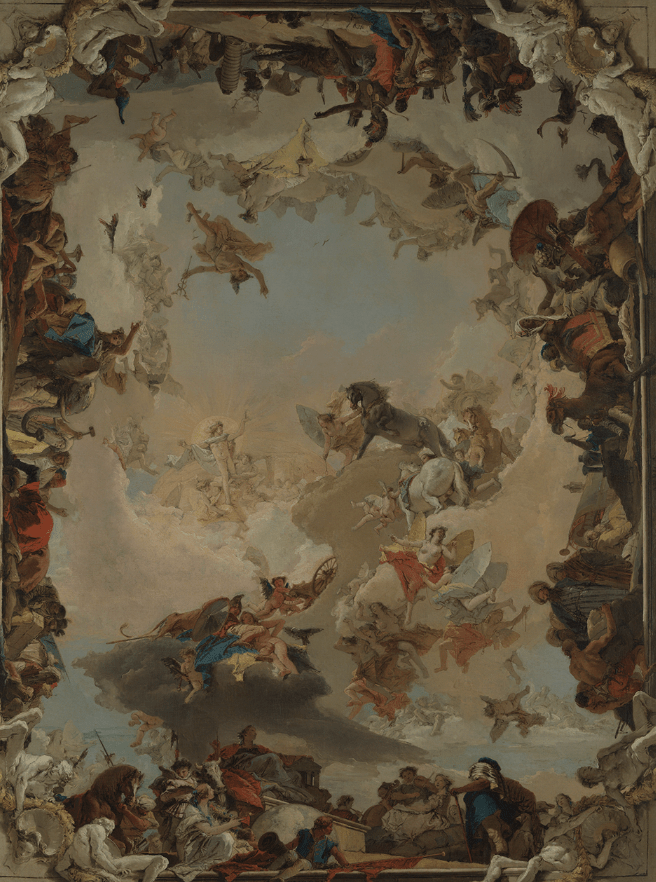
This was written in answer to the question “what is humanity’s true home?” in the Program of Liberal Studies’ 2023 essay prize competition
The following lines comprise my attempt at a modest treatise on “Love” if you will. I shoulder a burdensome task, determined to contemplate, “love that moves the Sun and other stars” in the evergreen words of Dante Alighieri. As I would have it, Love is mankind’s true home. It is also, perhaps, “the most important thing”: everyone must, at some point, battle the great, tender mystery of love. My reasoning is life-long, and consequently, tedious. Nevertheless, through recent experiences, I have abridged it and come to define love as a “phenomenon of emptying the self”. As one loves, they are filled up with the object of their love. In turn, the beloved is filled up with the lover, creating an endless exchange.
Love is not substance or deed; it is a “net negative” force, a movement, an urge that drains “ego” from self. Therefore, love involves a cost; true lovers happily dedicate their lives, and even bodies, for the benefit of each other. Imagine, then, two people splitting a jar of water who each possess a full glass. One of them decides to drink and empties their cup, while the other refills this cup with his or her own share. Hence, whenever this person is obliged to quench their thirst, they reach for the central jar and are replenished. After envisioning this, one question remained: what, or who, was the “jar”? Through discussion and further reflection, I have veered to Theology and assumed the “jar” is God. Love is a cyclical movement within the very essence of God, and further, God can only be Love if He is God in “Trinity and unity”. God is the fountain of love for our universe, and every striving inkling of love must be animated in Him and end with Him.
Indeed, love is, principally, a decision to surrender all. Love acts in faith and in trust, releasing self-possession and being open to the love that is returned. Our late Pope emeritus Benedict XVI agrees, stating, in his second encyclical letter, that man is altogether “redeemed by love”. When someone experiences love, he writes, life itself acquires new meaning. However, they also realize love “remains fragile”, unfulfilling. So, he believes, “the human being needs unconditional love”, and if it “exists, with its absolute certainty, then—only then—is man ‘redeemed’”. Finally, “whoever is moved by love begins to perceive what ‘life’ really is”, and as Ratzinger argues, that is beholding Jesus, “who said that He had come so that we might have ‘life and have it in its fullness, in abundance’”. Jesus also explained “what ‘life’ means: ‘…that they know You the only true God, and Jesus Christ whom You have sent’. Life in its true sense”, Ratzinger concludes, “is a relationship”, intimacy with God Himself, the very Breath of Life.
I then posited that maybe humanity’s ‘original sin’ was not the physical act of disobedience, but lacking in trust, an absence of manifested love. Adam and Eve doubted God’s goodness, believing knowledge would satisfy more than dependence. But the “tree of good and evil” did not limit humanity; it invited them into an even deeper bond of affection. When God created the world, He reproduced His nature of abundant, absolute Love, and designed humanity to be partners, stewards, and co-heirs of His benevolent kingdom. God’s relationship with humanity would not be stagnant, but rather, ever-blossoming in knowledge, maturation, and creative dynamism. If Adam and Eve had acknowledged the beauty in God’s direction and refrained from eating the fruit, perhaps they would have accessed the Tree’s “forbidden wisdom” and beyond in God’s time. The gospel of Luke supports this notion, recording how Jesus, although blameless and God incarnate, still “grew” in “wisdom and stature”. How can one grow in wisdom if one is already perfect? Doubtless, God intended the same for humanity. Drawing wisdom from God, a River of living water, mankind could have achieved ever-increasing heights of blessed companionship. Would they possess the confidence all they required for “the good life” would be provided? Did they believe God would lead them to a knowledge of His truths, and that they would have all glorious Eternity to contemplate the mysteries of their gentle Father?
I must conclude my speculations by emphasizing I do not want to claim God could or would have revealed the knowledge of the tree. Instead, I believe that if they only refuted the snake’s lies, Adam and Eve would have proved their love for God: simply, by trusting Him with a matter they could not, at that moment, fully understand. To love God is to trust Him. God invited Adam to walk when he could not discern the way, and this—as we know—proved too burdensome a task for him. Thus, Adam’s descendants have failed in the same manner ever since.
The narrative dialogues of Plato frequently reflect this moral, and it is what makes his “Symposium” so universally beloved. Plato discloses intimate mysteries of reality as Diotima, Socrates’ instructor, explains how one may unite with God. Diotima remarks that countless beauties may wound the heart or entrance the eyes; we are only satisfied, however, when we behold the realm of eternal, unchanging Forms, the most perfect of these being the “Good”. We readers must follow Socrates and Diotima, rising, “by stages…so that in the end” we come to know “just what it is to be beautiful”. But conflict stirs when one obnoxious and drunk Alcibiades interrupts the speech of Socrates, crying, “Good evening, gentlemen. I’m plastered”!
Plato’s central argument unfolds as we recall how, “love wants to possess the good forever”. According to Diotima, “Eros” is simply an imperfect participation in the immortality of the soul and desire for the good is the “treacherous love in everyone”. Plato invites us to move past what we understand through the senses. We must observe with eyes of the inner mind, understanding there exists a rival Goodness beyond anything found in our world. He does not disparage the world, and elevating it, draws attention to the spiritual reality so often obscured by material emphasis. In a similar manner, in his other dialogue, the “Phaedrus”, Plato argues “man’s fall” originates from the soul’s descent from its heavenly dwelling. Forgetfulness clouds all memory of this native homeland, and our condition sparks perpetual, insurmountable longing. It is only through recollection, prudently mastering both the unruly and gentle horse in one’s own tumultuous “chariot”, that our soul sprouts wings like it once possessed in an eternity past.
Humanity’s expulsion from Eden, the first “home”, resulted from our failure to love well. However, I have, after coursing through extensive pontifications, internalized how we may yet reenter that home. Jesus, the second Adam, and Mary, his mother, are the exact reversals of our predecessors and their failings: it is an ancient, simple tale. When in agony in the Garden of Gethsemane, Jesus prays for God’s will to be accomplished rather than his own, embracing the scourge of humanity’s sin; and when the angel Gabriel appears to Mary at the annunciation, she accepts Providence’s words, embracing the role of mother of God and declaring herself a “handmaid of the Lord”. They were disposed to welcome God’s direction and to choose Love, which I have previously defined as an act of pure “surrender”. Christ’s Passion, an expiation for sin, reveals an extraordinary, true, and most perfect love, as we observe literal blood and water flow from his side. As the “beloved” apostle John remarks, “God so loved the world that he gave his one and only Son”, so that we might taste the joys of life eternal. We are, in the words of St. Paul in his letter to the Colossians, “wholly and dearly loved” by God. Regardless of what we may believe about Christ, through the mere image of His sacrifice, we can flee our condition and strive toward a profound spiritual ascent, embarking on an “itinerary” (as St. Bonaventure exemplified). Jesus’ sacrifice on Calvary, combined with Mary’s obedience, serve as our model of ideal submission as well as the path to future redemption.
Love requires sacrifice; the tempests we encounter as we progress may not always be favorable. Regardless, we may, once more, be inspired by Pope Benedict XVI, who regularly demonstrated there is no love story more poignant than the one between God and mankind. As his breath failed, he allegedly exclaimed, “Lord, I love you”, a final measure of love and devotion. Like him, we may yet reach the biblical Paradise, where love is fecund and continually reproductive in beauty. We shall make this home lovely because the Light Himself will be our Sun. Love “that moves the Sun and stars” is our destination. Surrender, initially bleak and costly, provides utmost future gain. Paradoxically, it is only by giving up everything that we truly find our all.
Yet we may rise, presently, apart from mere hope of a future age. We climb the “ladder of beauty”, as theologians, ancient philosophers, and thinkers of all religions illustrate. By contemplating God and his Creation, we transcend our physical existence and inch closer to the nuptial mystery of the Lamb. But we can also find “heaven on earth”, realizing that perhaps, Heaven came to earth as a homely, poor, Jewish rabbi. Moreover, Earth reflects the very presence of God: when the wind whistles through a mighty foliage, when clouds gently beckon as they circumvent the earth, when the Moon smiles down at us with her glossy countenance; when Day’s brightness obscures weary eyes, or the harp strikes as pointed daggers do their victims; when birds proclaim a tuneful hymn and the flute joins in gracious emulation; when inspiration pours its sudden spasms of glistening perfumes—and an ornamented altar beguiles a bereft spirit with chimes of complacency—then, indeed, our souls may sate from all vain struggle. Music of human instruments is merely the vibration of matter. Tuned to the right frequencies, consonances emerge, inexplicably lovely to our ears. Likewise, humans are tuned to conditions allowing God’s “breath of life”, the invisible soul, to dwell within us. Our soul is as real, meaningful, and as curiously strange as the satisfaction of the right harmony. It is an emergent melody from our weary clump of flesh—a heavenly essence, unseen, yet most evidently perceived.
Another way to act beyond abstraction is by surrendering ourselves to God, body and soul. God made us creatures oriented by love; we cannot survive without it. When we love others, we also love Him. True love, therefore, is about willing the good of another; it gives up the “self” for the benefit of a neighbor, only to be seized with joy and filled with more of God, our cistern and better self. To love God, we must also “obey His commandments” and worship as He has asked. At the heart of the Christian religion there lies the sacrifice of a Son to a Father, the gift of body and blood to a Bride for His possession. His cross, the most tangible demonstration of surrender, reminds us of God’s nature of pure Love, and so we worship Him by reliving the Passion in His memory. By adjoining ourselves to Christ’s suffering or participating in the liturgy, we unite with God using marriage bonds crafted by the Bridegroom himself. Evoking the gift of love from Son to Father, we are reminded of our humble Way of Life.
While we often picture Eternity with God as a path that will inevitably result in boredom, St. Anselm helpfully refutes our conception for us in his famous “Proslogion”. He identifies the true meaning of blessed communion, explaining how, indeed, “the more one loves someone, the more one rejoices in his good…everyone in perfect happiness will love God incomparably more than himself and others…everyone will rejoice inconceivably more in God’s happiness than inhis own, or in that of everyone else with him”. In a momentary act of surrender, we find eternal respite—we behold Love Himself, completely and forever.
 Brain in a Vat